Water Chemistry 201: Bicarbonate Buffering
In our first deep dive into water chemistry, we explored the roles of Magnesium and Calcium in "pulling" flavors from the bean. But there is a second half to the equation that is arguably more important for sensory balance: **Alkalinity**. This 1,500-word technical analysis explains the role of Bicarbonates ($HCO_3^-$) in buffering coffee acidity and protecting your equipment.
Understanding Alkalinity: The Acid Buffer
While "Hardness" refers to the minerals (Ca and Mg) that assist in extraction, **Alkalinity** refers to the water's ability to neutralize acids. In coffee, the most common alkaline component is the **Bicarbonate** ion. When you brew coffee, you are extracting a wide array of organic acids (citric, malic, phosphoric, quinic). If your water has zero alkalinity, these acids will dominate the cup, resulting in a sharp, "vinegary" acidity that lacks balance.
Bicarbonates act as a "buffer." When they come into contact with the acids in coffee, they react to form CO2 and water, effectively "muting" the sharp edges of the acidity. This creates a "rounder," more harmonious cup. However, too much alkalinity will neutralize *all* the acidity, leaving the coffee tasting flat, chalky, and dull.
The Sensory "Sweet Spot"
For specialty coffee, the Specialty Coffee Association (SCA) recommends an alkalinity level of approximately **40 mg/L (ppm)**. At this level, the water has enough buffering capacity to smooth out the intense acidity of light-roasted East African coffees without sacrificing the "sparkle" that defines high-end terroir. If you are brewing a darker roast, which is naturally lower in acidity, you might prefer a lower alkalinity (around 20 mg/L) to prevent the coffee from tasting "hollow."
LSI: The Langelier Saturation Index
Alkalinity is not just about flavor; it is about the health of your espresso machine. When minerals like Calcium Carbonate precipitate out of the water, they form "scale." Scale can clog boilers, ruin heating elements, and destroy flow meters. The tendency of water to form scale is measured by the **Langelier Saturation Index (LSI)**.
The LSI is a complex calculation that takes into account pH, temperature, Calcium hardness, and alkalinity. An LSI of 0 means the water is perfectly balanced. A positive LSI (e.g., +0.5) indicates that the water will form scale. A negative LSI (e.g., -0.5) indicates that the water is "hungry" or corrosive, and will begin to eat away at the copper and brass components of your machine. For an authority-level setup, maintaining an LSI between -0.2 and +0.2 is essential.
Custom Mineral Recipes: The Lotus and TWW Approach
In the pursuit of perfection, many baristas have moved away from tap water entirely. Instead, they start with distilled or Reverse Osmosis (RO) water and add minerals back in using precise "recipes." This is popularized by companies like **Third Wave Water** or **Lotus Coffee Brew Water**.
A typical high-end water recipe might look like this:
- Distilled Water: 1 Liter
- Magnesium Sulfate (Epsom Salt): 50 mg (for extraction power)
- Calcium Chloride: 25 mg (for mouthfeel)
- Potassium Bicarbonate: 40 mg (for buffering capacity)
By using Potassium Bicarbonate instead of Sodium Bicarbonate (baking soda), you can achieve buffering without adding the "salty" flavor profile associated with sodium.
Measuring with Precision: Titration Kits
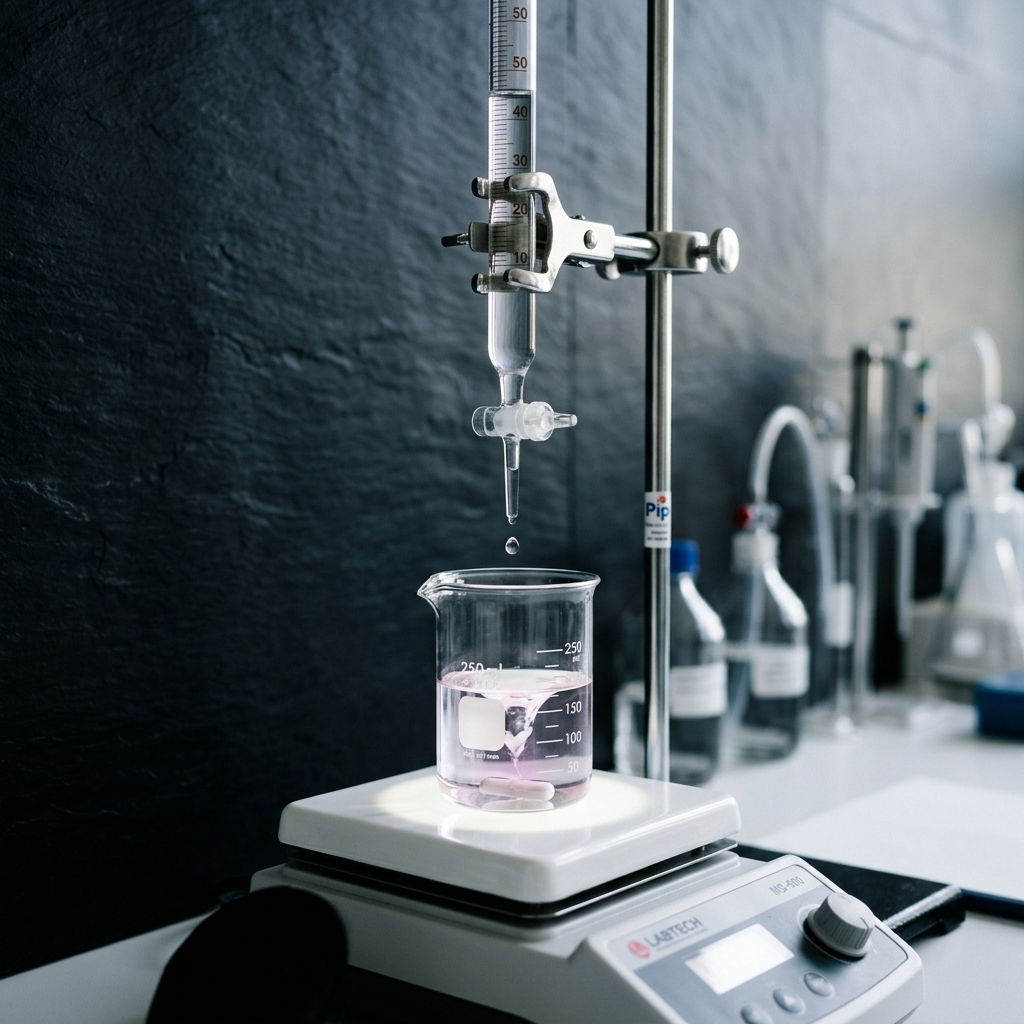
How do you know your alkalinity level? While TDS meters are common, they only measure *total* dissolved solids—they cannot distinguish between hardness and alkalinity. For that, you need a **Titration Kit** (like the API GH/KH test kit or a digital titrator). By adding drops of a reagent to a water sample until the color changes, you can calculate the alkalinity with 1-drop (17.9 ppm) precision. In a professional lab setting, this test is performed weekly to ensure consistency as municipal water supplies fluctuate with the seasons.
Conclusion: The Final Ingredient
Water is 98% of your coffee. If you are spending $50 on a bag of Geisha but brewing it with unbuffered, unbalanced water, you are throwing your money away. Understanding the chemistry of bicarbonates and the role of alkalinity is the final step in the journey of coffee mastery. In our next installment, we will shift our focus to the "Roast Lab" to discuss **The Chemistry of the Maillard Reaction** and how heat transforms green seeds into aromatic gold.