Pour-Over Mastery: Precision & Geometry
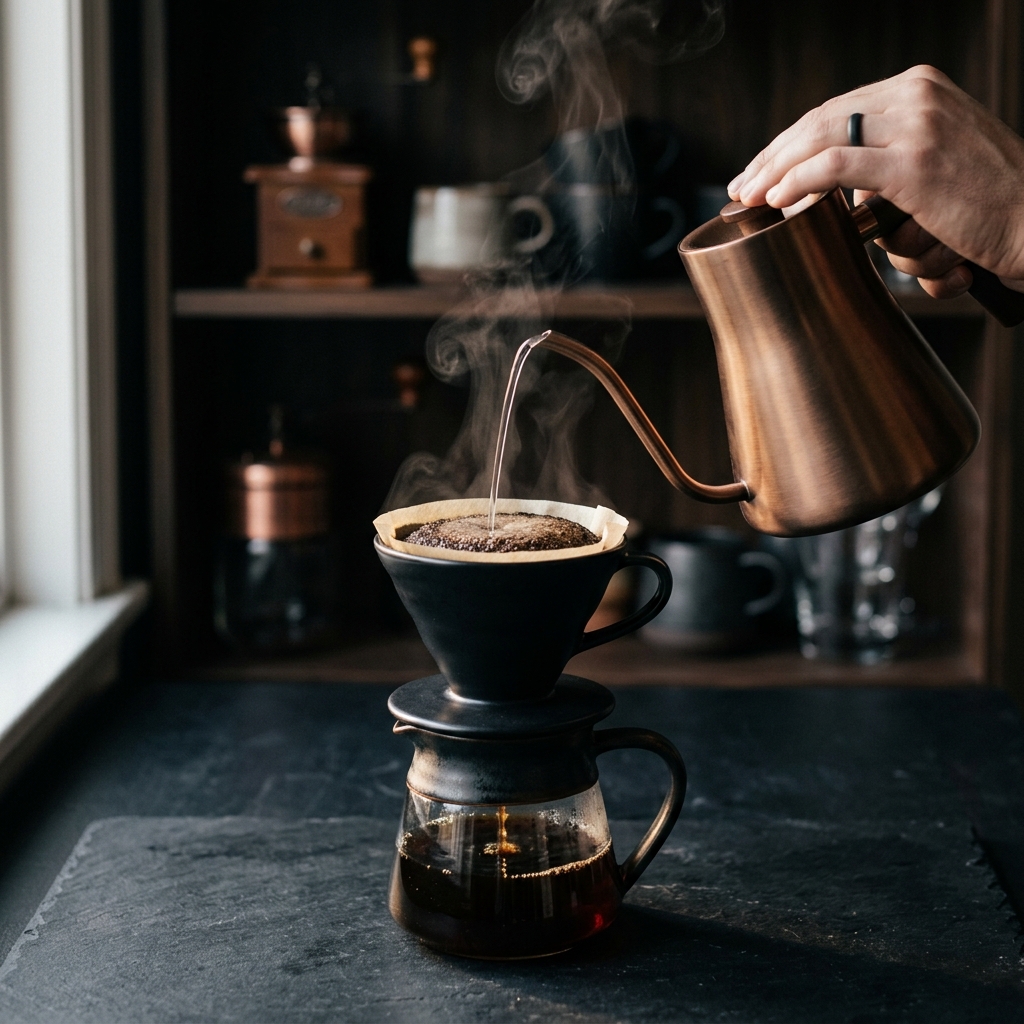
Pour-over brewing is the ultimate expression of the barista's skill. Unlike immersion methods, where variables are "set and forget," pour-over (percolation) requires active management of flow rate, turbulence, and bed geometry. In this 1,500-word masterclass, we explore the physics of the V60 and Kalita Wave.
Conical vs. Flat-Bottom Geometry
The choice of brewer is not just aesthetic; it's a choice of fluid dynamics. The two titans of the specialty world, the **Hario V60** and the **Kalita Wave**, represent two different philosophies of extraction.
The V60 (Conical): Its 60-degree angle and single large exit hole prioritize clarity and acidity. Because the water passes through a deeper bed of coffee at the center, the extraction is highly dependent on your pour technique. If you pour too fast, the water will "bypass" the grounds via the sides. If you pour too slow, the coffee will over-extract. The V60 is the "Formula 1" of brewers—capable of the highest performance but unforgiving of error.
The Kalita Wave (Flat-Bottom): The three small holes and flat bottom create a more uniform bed of coffee. This encourages "even extraction" by slowing down the flow and ensuring all grounds are in contact with water for a similar duration. The Kalita Wave produces a heavier mouthfeel and more consistent sweetness, making it the preferred choice for those who want a reliable, high-quality cup every morning.
The Physics of the Pour
The way you add water is as important as the water itself. A gooseneck kettle is essential because it allows you to control the **vertical force** of the water stream. When water hits the slurry, it creates turbulence. Controlled turbulence is good—it "stirs" the grounds and prevents channeling. Uncontrolled turbulence leads to "high-and-dry" grounds on the filter walls, which do not contribute to the extraction.
The standard "circular pour" serves two purposes: it ensures all grounds are saturated, and the centrifugal force helps to keep the coffee bed level. Most precision recipes involve a "Bloom" phase (doubling the weight of the coffee in water) to allow CO2 to escape, followed by 2-3 controlled "pulses" to maintain a steady water level and extraction pressure.
Filter Dynamics: The Paper Variable
A often-overlooked variable is the filter itself. The V60 uses thin, large-pore paper that allows more oils and fine particles through, emphasizing fruitiness. The Kalita Wave's "wave" shape isn't just for looks; the air pockets between the paper and the brewer act as thermal insulation and prevent the filter from sticking, which maintains a consistent flow rate. In our next article, we will dive deeper into **The Filter Factor**, comparing metal mesh, cloth, and bleached paper.
Conclusion: Developing Your Signature Pour
There is no "perfect" pour-over recipe—only the one that highlights the specific notes of your beans. By understanding the geometry of your brewer and the dynamics of your pour, you can dial in a profile that is uniquely yours. In the next section of The Brew Bar, we will explore the fundamental differences between **Immersion vs. Percolation** to help you decide which method suits your palate.