The Grind Size Matrix: Particle Geometry & Extraction
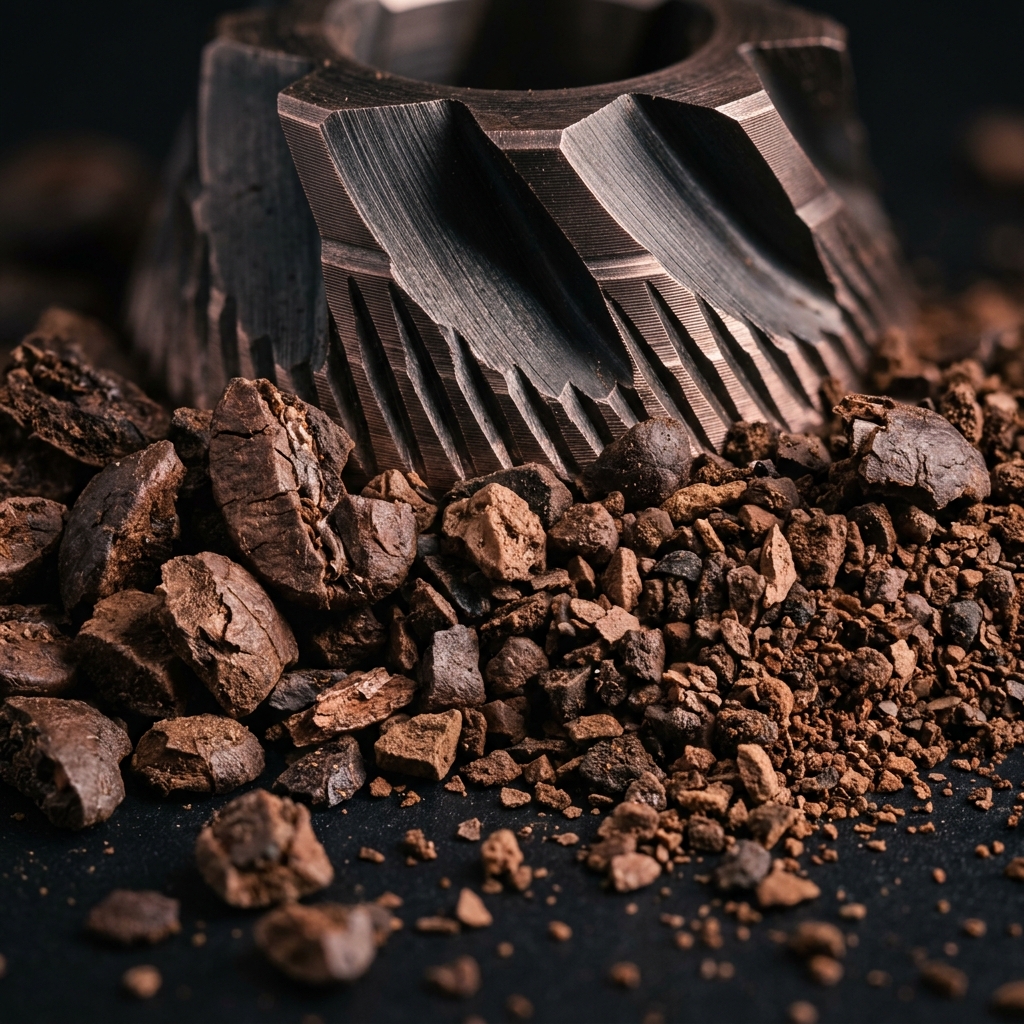
In the quest for the perfect cup, we often obsess over water temperature and bean origin, yet the most critical mechanical variable is frequently misunderstood: the grind. Grind size is not just about "fine" or "coarse"; it is about **surface area**, **particle distribution**, and **pore velocity**. This 1,400-word analysis explores the physics of the grind and its impact on extraction dynamics.
Surface Area and the Extraction Gradient
Extraction is a process of diffusion. When water contacts a coffee particle, it dissolves soluble compounds—acids first, then sugars, and finally bitter cellulose and fibers. The speed of this diffusion is directly proportional to the surface area available. A single coffee bean ground for espresso is shattered into thousands of microscopic pieces, increasing the surface area exponentially compared to a coarse French Press grind.
The "Matrix" comes into play when we realize that extraction is not uniform. In a coarse grind, the water may fully extract the exterior of the particle while the core remains "under-extracted." In a fine grind, the water can penetrate the entire particle quickly, leading to the risk of "over-extraction" if the contact time is not precisely controlled.
The Bimodal Distribution Problem
No grinder produces perfectly uniform particles. Every grind contains a "Bimodal Distribution" of **Fines** (microscopic dust) and **Boulders** (larger chunks). High-end flat burr grinders, like those from Mahlkönig or Weber Workshops, are engineered to minimize this spread, creating a more "unimodal" distribution.
Fines are the enemy of clarity. Because of their massive surface area relative to their volume, they over-extract almost instantly, introducing astringency and bitterness. Boulders, on the other hand, contribute to a "thin" mouthfeel as they fail to yield their full sweetness in the time allowed. Achieving the "Golden Cup" requires a grinder that can provide a narrow distribution curve, ensuring that every particle is contributing the same flavor profile to the final brew.
Burr Geometry: Flat vs. Conical
The debate between **Flat Burrs** and **Conical Burrs** is one of geometry and heat. Conical burrs tend to produce a more bimodal distribution, which is often preferred for traditional espresso as the "fines" provide the body and texture needed for a rich crema. Flat burrs, however, produce a more uniform grind, which is the gold standard for modern "high-clarity" espresso and pour-over methods.
Furthermore, burr material (stainless steel vs. ceramic vs. titanium coating) affects heat retention. As burrs heat up during high-volume use, they can cause the coffee oils to oxidize, altering the flavor before the water even touches the grounds. Precision engineering in the Brew Bar focuses on maintaining thermal stability within the grinder itself.
The "Lazy Water" and Channeling
In percolation methods like V60 or Espresso, the grind size also dictates the **hydraulic resistance** of the coffee bed. If the grind is too fine or uneven, the water will find the "path of least resistance," creating a **channel**. Channeling is the death of quality; it results in a cup that is simultaneously bitter (from the over-extracted channel) and sour (from the under-extracted surrounding coffee). Precision distribution and a unimodal grind are the only cures for this "lazy water" problem.
Conclusion: Engineering the Grind
Mastery of the grind size matrix is what separates the enthusiast from the professional. By understanding the microscopic geometry of our coffee, we can manipulate the extraction to highlight specific notes—from the bright citric acidity of a light-roast Ethiopian to the deep cocoa sweetness of a Colombian estate. In our next installment, we will explore the ritual and physics of **The Chemex Experience: Focus on the Filter Factor**.