The Mathematics of Extraction Yield
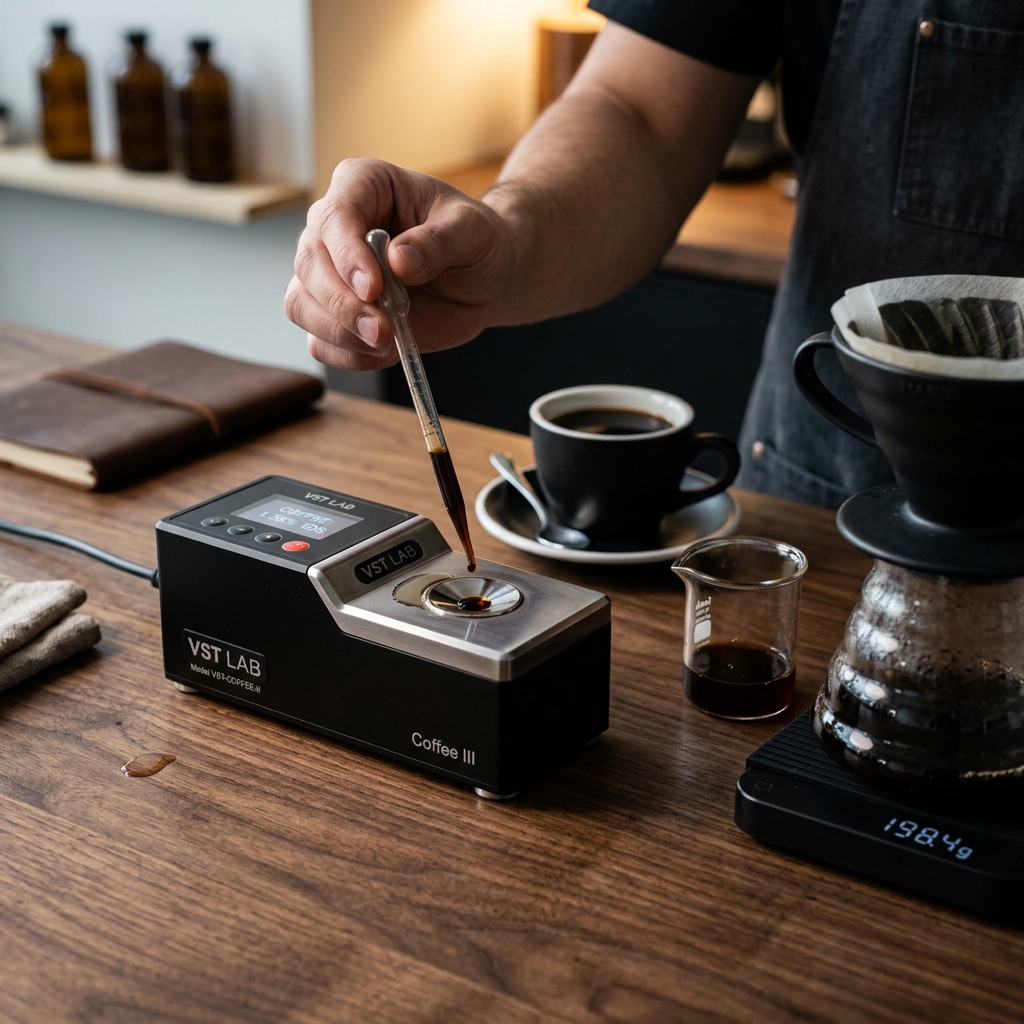
In the world of specialty coffee, "tasting" is subjective, but "extraction" is a mathematical certainty. For the professional barista, the refractometer is not just a gadget—it is the ultimate arbiter of quality control. This 1,500-word deep dive explores the physics of Total Dissolved Solids (TDS) and the formulas that define the "Golden Cup."
TDS vs. Extraction Yield: Defining the Terms
Before we dive into the math, we must distinguish between two frequently confused terms: **TDS** and **Extraction Yield (EY)**.
- Total Dissolved Solids (TDS): This is a measure of the *strength* of the brew. It tells you what percentage of your final cup is actually coffee solids versus water. For a typical filter coffee, TDS usually sits between 1.15% and 1.45%. For espresso, it can range from 8% to 12%.
- Extraction Yield (EY): This is a measure of *efficiency*. It tells you what percentage of the original dry coffee grounds was actually dissolved into the water. The specialty coffee standard (the "Golden Cup") defines an ideal EY between 18% and 22%.
A coffee can be strong (high TDS) but under-extracted (low EY), resulting in a sour, salty cup. Conversely, it can be weak (low TDS) but over-extracted (high EY), resulting in a bitter, hollow cup. The goal of mathematical brewing is to find the "sweet spot" where both metrics align.
The Physics of Refractometry
How do we measure something as invisible as dissolved solids? The answer lies in the **Refractive Index**. When light passes from one medium (air) into another (brewed coffee), it bends. The amount of "bend" is determined by the density of the liquid. A digital refractometer, like the VST Lab Coffee III, shines a light through a drop of coffee and measures the angle of refraction with extreme precision. It then uses an algorithm to convert that refractive index into a TDS percentage, adjusted for the temperature of the sample.
Precision is key. A single fingerprint on the sensor or a sample that hasn't been properly filtered through a syringe filter can skew the results by as much as 0.10%, which is the difference between a perfect brew and a mediocre one.
The Extraction Yield Formula
Once you have your TDS reading, you can calculate your Extraction Yield using the following fundamental formula:
EY% = (Brewed Coffee Weight × TDS%) / Dose Weight
Let's walk through a real-world example:
- Dose: 20.0g of dry coffee.
- Brewed Coffee Weight: 300g (the weight of the liquid in the server).
- Measured TDS: 1.35%.
Using the formula: `(300 * 0.0135) / 20 = 0.2025`, or **20.25% EY**. This falls perfectly within the ideal range. If the EY had been 16%, we would know—without even tasting—that we need to grind finer or increase our water temperature to achieve more extraction.
The "Fines" Problem: Sieve Analysis and Uniformity
Math only works if the extraction is uniform. If your grinder produces a wide range of particle sizes (many "fines" and many "boulders"), your EY might *look* correct on paper, but the cup will taste muddy. The fines will be over-extracted (bitter), and the boulders will be under-extracted (sour). This is why authority-level brewing requires high-end flat-burr grinders (like the EK43 or Mazzer ZM) that produce a unimodal particle size distribution. When every particle is the same size, the math of extraction becomes predictable and repeatable.
Data-Driven Dialing In
Using a refractometer changes the "dialing in" process from a guessing game to a scientific experiment. Instead of saying "this tastes a bit sour," a barista can say "this is at 17.5% EY; I need to increase my yield by 10 grams to hit 19%." This level of precision allows for:
- Consistency across shifts: Multiple baristas can produce the exact same flavor profile.
- Waste reduction: Dialing in a new coffee takes 2-3 shots instead of 10.
- Troubleshooting: If a coffee suddenly tastes different, the TDS reading can quickly identify if the issue is with the grinder, the water temperature, or the dose.
Conclusion: The Marriage of Palate and Probe
Mathematical brewing is not intended to replace the human palate; it is intended to calibrate it. A refractometer won't tell you if a coffee tastes like "jasmine" or "blackcurrant," but it will tell you if you are giving that coffee the best possible chance to express those notes. By mastering the math of extraction, we move away from the "magic" of the barista and toward the "mastery" of the scientist. In our next installment, we will zoom out from the brew bar to the farm, exploring how **Terroir and Genetics** create the raw potential we strive to extract.