Espresso Puck Prep: The Science of Distribution
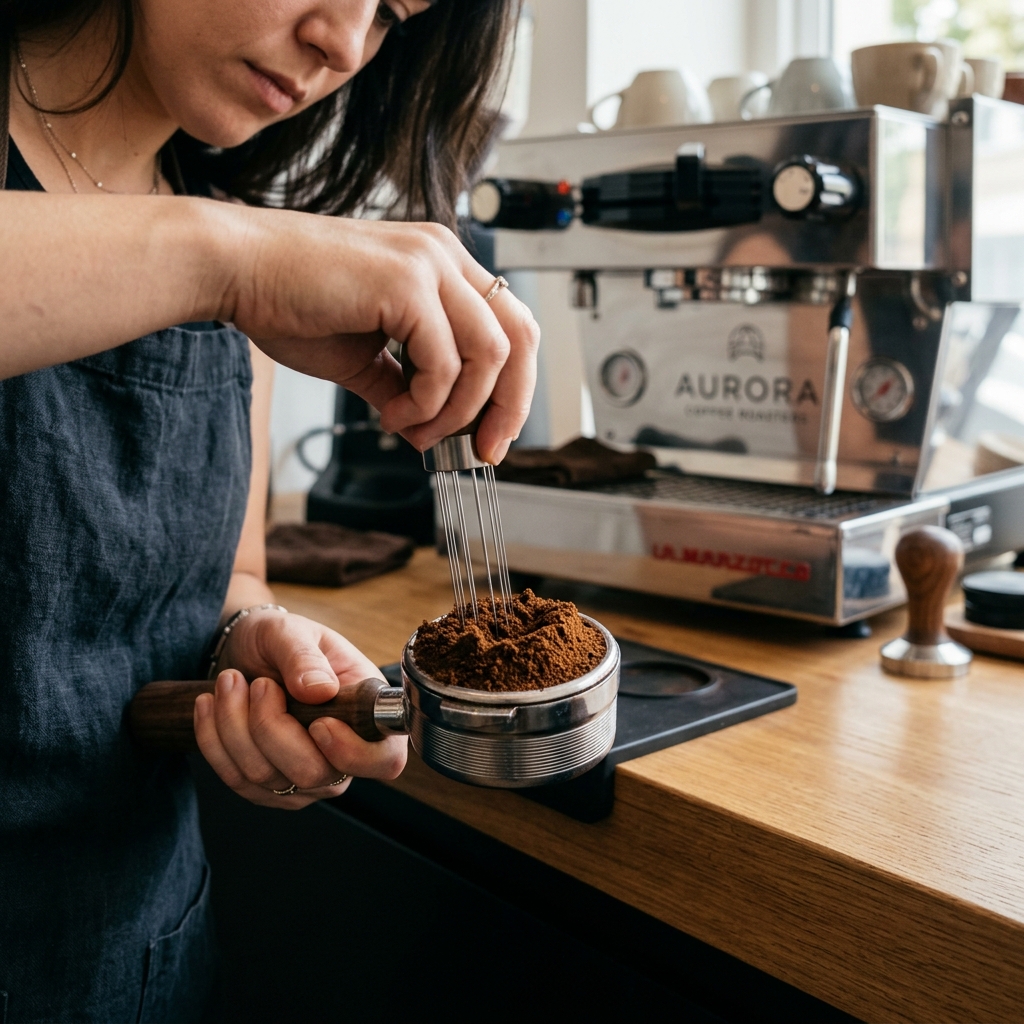
Espresso is brewing under high pressure—typically 9 bars (130 psi). At this pressure, water is lazy. It will always find the "path of least resistance." If your coffee puck has even the slightest inconsistency in density, the water will rush through that area, creating a "channel." This 1,400-word deep dive explores the physics of channeling and the tools used to achieve a perfect distribution.
The Channeling Problem
When channeling occurs, the water bypasses the majority of the coffee grounds. This leads to a dual problem: the coffee in the channel is **over-extracted** (bitter and astringent), while the coffee everywhere else is **under-extracted** (sour and salty). The result is a shot that lacks sweetness and balance. To prevent this, the barista must ensure that the coffee grounds are distributed with absolute uniformity across the entire portafilter basket.
WDT: The Weiss Distribution Technique
One of the most effective tools for distribution is the **WDT (Weiss Distribution Technique)**. This involves using a series of fine needles (typically 0.3mm to 0.4mm in diameter) to stir the coffee grounds in the basket. WDT serves two purposes:
- De-clumping: Grinders, especially those with high static, can produce small clumps of coffee. These clumps create pockets of high density. WDT breaks these clumps apart.
- Homogenization: Stirring the grounds from the bottom up ensures that the density is the same from the top of the puck to the bottom.
Scientific testing using refractometers has shown that a proper WDT technique can increase extraction yield by as much as 2% while significantly reducing the standard deviation between shots.
The Physics of Tamping
Tamping is often misunderstood as a "strength" exercise. In reality, the goal of tamping is not to "compress" the coffee (which is largely incompressible) but to **remove the air gaps**. Once the air gaps are removed, additional pressure has no effect on the shot. This is why modern precision tampers (like those from Pullman or Pergtamp) focus on **fit** rather than pressure.
A standard tamper often leaves a 1mm gap around the edge of the basket. This "ring" of uncompressed coffee is a prime location for side-channeling. Precision tampers are designed to fit the basket within a tolerance of 0.05mm, ensuring that the entire puck is sealed against the walls of the basket.
OCD and Levelling Tools
Levelling tools, like the **Ona Coffee Distributor (OCD)**, use a spinning wedge to flatten the surface of the coffee. While these tools make the puck *look* perfect, they only address the top 2-3mm of the grounds. If the bottom of the basket is uneven, a levelling tool will actually hide the problem rather than fixing it. This is why many top-tier baristas use WDT first, followed by a levelling tool, and finally a precision tamp.
Precision Baskets: VST and IMS
Your prep is only as good as the basket holding it. Standard portafilter baskets are manufactured with punched holes that vary in size and distribution. This creates "dead spots" where no extraction occurs. **Precision Baskets** (like those from VST or IMS) are manufactured using laser-drilled holes with a 0.01mm tolerance. Every hole is the exact same size, ensuring that the flow of water is perfectly even across the entire surface of the puck.
The "Paper Filter" Revolution
A recent trend in high-end espresso is the use of a small paper filter at the bottom of the basket. This serves two functions. First, it prevents "fines migration," where the smallest coffee particles clog the holes of the basket. Second, it allows for a much higher flow rate, which in turn allows the barista to grind even finer without choking the machine. This "high-flow" espresso technique can push extraction yields toward 25%, resulting in an incredibly sweet, tea-like clarity in the cup.
Conclusion: Precision as a Habit
Puck prep is the most labor-intensive part of a barista's workflow, but it is also the most rewarding. By understanding the physics of distribution and utilizing the right tools, we can eliminate the variables that lead to poor extraction. In our next installment, we will explore **The Science of Sensory Analysis**, teaching you how to calibrate your palate to detect the subtle differences these technical changes make.