Precision Roast Logging with Artisan Scope
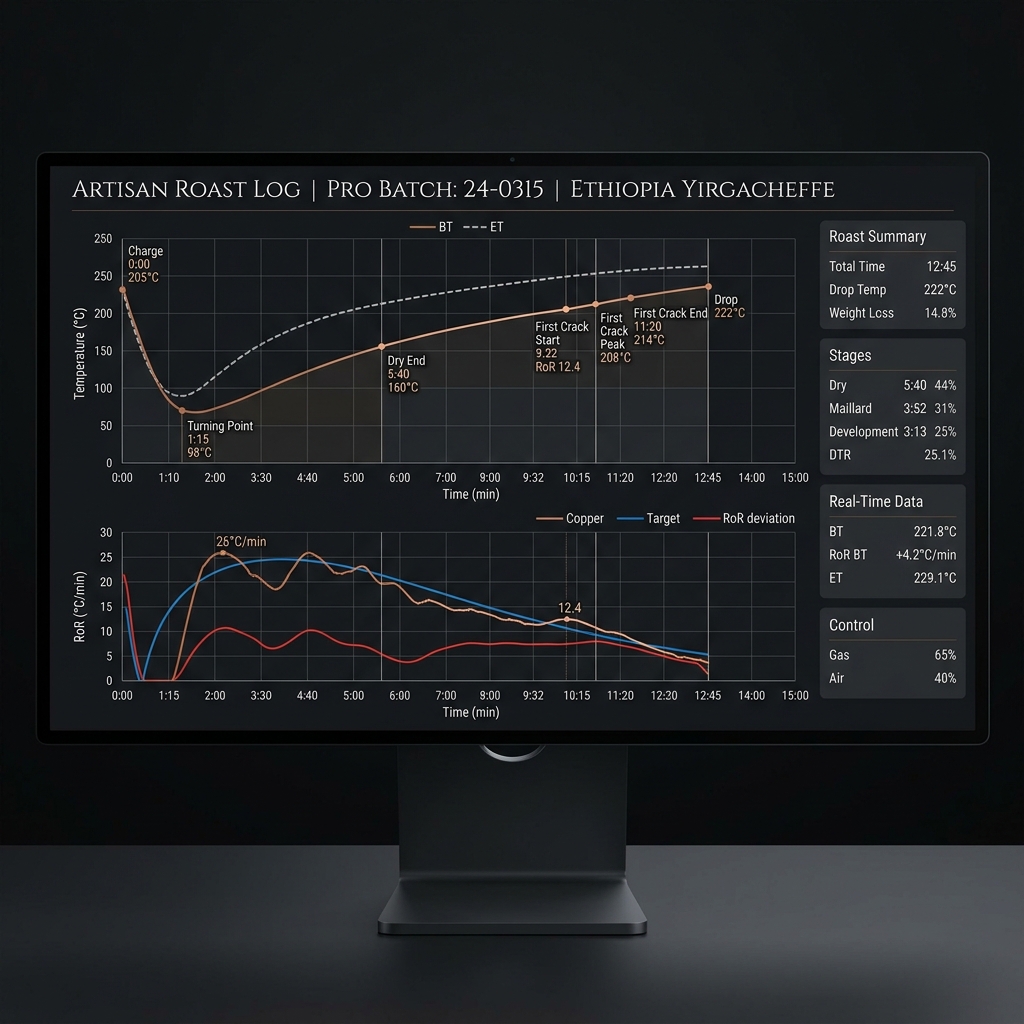
In the world of specialty coffee, consistency is the ultimate metric. For the artisan roaster, the transition from "roasting by sight" to "roasting by data" is a watershed moment. At the center of this digital revolution is **Artisan Scope**, an open-source software that has become the industry standard for roast logging and analysis. This 1,500-word technical guide explores the hardware integration and data analysis required for absolute mastery of the roast curve.
The Hardware Bridge: Phidgets and Thermocouples
Artisan doesn't roast the coffee; it listens to it. To get high-resolution data into the software, we must bridge the gap between the roaster's heat and the computer's CPU. This is typically achieved using **Type K Thermocouples** and a **Phidgets 1048** or VINT Hub interface. Unlike standard digital thermometers, these high-precision sensors can capture temperature changes in increments as small as 0.01°C, providing the granular detail needed to calculate **Rate of Rise (RoR)** in real-time.
Proper placement of the probe—ensuring it is submerged in the "bean mass" but not touching the drum wall—is critical. Any interference with the airflow or drum contact will result in "noisy" data, making it impossible to identify the subtle markers of first crack or development velocity.
Understanding Rate of Rise (RoR)
The most important graph on an Artisan screen is not the Bean Temperature (BT) curve, but the **Rate of Rise (RoR)**. RoR represents the velocity of temperature change—how many degrees the beans are heating up per minute. A master roaster looks for a **constantly declining RoR**. If the RoR "flicks" upward at the end of a roast, it indicates a sudden burst of exothermic energy that can scorch the delicate aromatics created during the Maillard phase. Conversely, a "crash" in RoR indicates the roast has stalled, leading to "baked" flavors and a loss of acidity.
Artisan Markers: First Crack and Development Time
Artisan allows roasters to drop digital markers for critical events: **Charge**, **Dry End**, **First Crack Start (FCs)**, and **Drop**. By marking these precisely, the software automatically calculates the **Development Time Ratio (DTR)**. For specialty light roasts, a DTR of 15% to 20% is often the "sweet spot." Artisan's ability to overlay a "Background Profile" from a previous successful batch allows the roaster to follow a proven "ghost" curve, ensuring that every batch of Ethiopian Yirgacheffe tastes exactly like the one before it.
Advanced Analysis: DeltaBT and Airflow Integration
Beyond basic temperature tracking, advanced users integrate airflow and burner controls into Artisan. By logging when adjustments are made to the gas pressure or fan speed, roasters can analyze how these changes impact the heat transfer efficiency. The **DeltaBT** metric (the first derivative of the bean temperature) becomes a predictive tool, allowing the roaster to anticipate a crash and adjust heat *before* the curve begins to fail.
Conclusion: The Digital Palate
Artisan Scope is more than just a logger; it is an extension of the roaster's sensory perception. By quantifying the physics of heat transfer, we remove the guesswork from the Roast Lab. As we continue to refine our profiles, the data tells the story of the bean's journey through the Maillard reaction and beyond. In our next article, we shift focus to the chemistry of the grind in **The Grind Size Matrix: Particle Distribution and Extraction Dynamics**.